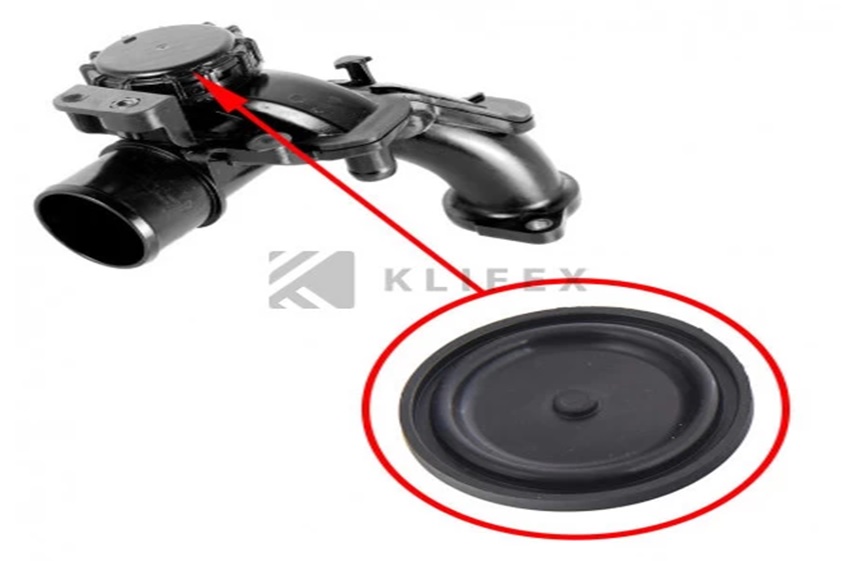
Exhaust gas recirculation works quietly in the background until something interrupts its operation. Its purpose is to return a measured quantity of exhaust gas to the intake, helping lower combustion temperature and reduce nitrogen oxide emissions.
In vacuum-operated EGR systems, a flexible diaphragm converts vacuum into valve movement. If that diaphragm hardens, splits, or leaks, the valve may no longer open or close as intended. The symptoms can resemble carbon build-up, vacuum-line failure, sensor problems, or unrelated fueling faults, so diagnosis matters.
How a Vacuum-Operated EGR Valve Works
A pneumatic EGR valve depends on more than the valve body. Vacuum from the engine’s vacuum system is regulated and delivered to an actuator. The diaphragm responds to the pressure difference, moving the valve through a rod or internal mechanism.
When the system works correctly, exhaust gas flow is controlled rather than continuous. Motorservice notes that faults such as P0400, P0401, and P0402 can correspond to missing, insufficient, or excessive EGR flow, while pneumatic valves should be checked for both vacuum supply and the ability to hold vacuum.
1. Rough or Uneven Idle
An EGR valve that remains open when it should be closed can introduce too much exhaust gas at idle. Because exhaust gas contains little oxygen, excessive recirculation can dilute the fresh charge and destabilise combustion.
The driver may notice vibration, an uneven idle, or an engine that feels close to stalling. Yet intake leaks, ignition problems, and fueling faults can create similar behaviour.
2. Hesitation During Acceleration
Acceleration requires the engine to respond quickly to changing air, fuel, and load conditions. If the diaphragm cannot move the EGR valve to the commanded position, exhaust gas flow may no longer match the engine-management strategy.
The result can be hesitation or a flat response when the accelerator is pressed. Motorservice lists deficient driving behaviour and insufficient performance among the symptoms associated with EGR flow faults.
3. Reduced Engine Performance
A leaking diaphragm can prevent the actuator from developing enough force to move the valve fully. Conversely, a valve that remains partly open can disturb the fresh-air charge entering the cylinders.
Either condition can make the engine feel less responsive, particularly under load. Some vehicles may also limit performance if the control system detects an emissions-related fault serious enough to trigger a protective mode.
4. Fuel Consumption Can Rise
Incorrect EGR operation can alter combustion efficiency and force the engine-management system to compensate. Drivers may therefore notice higher fuel consumption.
This symptom should be interpreted carefully. Tyre pressure, driving conditions, injectors, airflow sensors, and many other factors influence fuel economy.
Increased consumption becomes more useful diagnostically when it appears alongside other EGR-related evidence.
5. EGR-Related Fault Codes May Appear
Modern diagnostics can identify when EGR flow falls outside the expected range, although a fault code does not automatically prove that the diaphragm has failed.
Codes in the P0400-P0409 family can point towards EGR system problems. Possible causes include carbon restriction, inadequate vacuum, electrical-control faults, contaminated airflow sensors, sticking valves, or actuator problems.
This is where component-level inspection becomes valuable. On suitable vacuum-operated designs, EGR membranes can be assessed as part of the actuator rather than assuming that the complete EGR assembly is defective.
6. The Actuator Cannot Hold Vacuum
For a pneumatic EGR valve, this is one of the most revealing tests. If a vacuum is applied with a hand-operated vacuum pump and the actuator cannot maintain it, leakage may exist through the diaphragm or elsewhere in the actuator circuit.
Motorservice recommends testing pneumatic EGR valves with a hand vacuum pump and checking vacuum lines for continuity and tightness.
Diaphragm Failure and Carbon Build-Up Are Different Problems
EGR systems operate where soot, oil vapour, and exhaust deposits can accumulate.
A valve may therefore stick even when its diaphragm remains intact. Likewise, a healthy valve can fail to move if the vacuum hose, control solenoid, or pressure transducer is defective.
A sound diagnostic sequence asks three questions:
Is the vacuum reaching the actuator?
Can the actuator hold it?
Can the valve and linkage move freely?
That distinction helps separate a leaking diaphragm from a carbon-bound valve.
Conclusion
An EGR diaphragm has a simple task: converting controlled vacuum into movement. When that movement becomes unreliable, the effects can include rough idle, hesitation, reduced performance, increased fuel use, diagnostic codes, or an actuator that cannot hold vacuum.
Because these symptoms overlap with several other engine faults, testing the vacuum circuit and mechanical movement before replacing components is essential. It can reveal whether the real problem lies in the diaphragm, vacuum supply, carbon accumulation, or another part of the control system.